Resonating with audiences is vital
[4 June 2020] How audiences move and behave has changed dramatically, and it’s unlikely we’ll ever go back to life as it was. Home working is the norm for more people than ever before, and many think the days of 9-5 office-based work are a thing of the past. The impacts of this are wide ranging, from a workforce that needs to learn to adapt to remote working and the challenges that brings, to less demand for housing within commuter districts. House hunters will be looking for more space for home offices, made affordable because they don’t need to live so close to main towns and cities. If the office workers leave the city centre by day, it puts more pressure on struggling retailers on the high streets.
For those of us who have made the switch to home working and schooling, there’s an extra few hours in the day that would have been spent commuting and school drops. While the journey to and from work is a chance to refocus and reset for many, with no commute lots of people are taking the chance to take some exercise closer to home, or pop to their local shop rather than one near the office.
Media consumption
All of this changes how we consume media. The Google mobility data for Northern Ireland shows that the audience in residential areas has increased by 20% from the baseline. This confirms the theory that audiences are consuming media closer to home rather than during their commute or working day. Rather than looking at the lack of commuter time, it’s important to consider that the movement patterns haven’t vanished, rather they’ve just shifted.
According to research undertaken by Facebook India and Boston Consulting Group, brands need to focus on hyper-localisation by connecting with consumers where they are. The ‘Turn the Tide’ report highlights that countries are being divided into different zones with varying restrictions, so brands need to build relevant connections by engaging with consumers in their context.
Out of Home is capable of delivering these highly targeted, localised adverts. Classic formats deliver strong coverage provincewide, with the capacity to display as many creatives as required. Where hyper-localisation really comes into its own however, is through Digital Out of Home, and in particular Dynamic OOH. Multiple creatives and day-part scheduling on Digital OOH is standard ensuring messages are tailored towards the audience at all times. Additionally, DOOH is more reactive, and can be live on streets within hours of booking, particularly important for brands that need to act quickly to promote opening schedules.
Ad uplift of 17%
Dynamic campaign elements have been shown to increase campaign metrics, with Posterscope’s The Moments Of Truth whitepaper showing spontaneous ad awareness for relevant ads increased by 17%. Dynamic triggers can range from live sales information, weather, traffic/public transport data or live sport scores, to name just a few. It remains untested, but there is no reason that retailers couldn’t use Digital Out of Home to advise consumers how long queues are at their stores or highlighting typically quiet times. Additionally, this could be done in proximity to rival stores, luring customers from a queue to a quieter competitor.
Flexibility, agility and relevance will be key ingredients in designing communications in the coming months, if not years:
- Flexibility – the need to flex how, where and when advertisers talk to people
- Agility – the need to react at speed to new demands, behaviours and insights
- Relevancy – the need to make messaging appropriate and sensitive to changing moods and events
As we head into the near and next phases of the pandemic, with restrictions easing, OOH, and Digital OOH specifically, will in fact be well placed to respond to these needs – reaching audiences wherever they are and as they relish their time back out in the world with an appetite for the new and different.
When audiences have shifted in their behaviours, and brands need to build meaningful relationships that speak to the consumer in the moment, Out of Home can deliver. People look to OOH for honest and reliable messages, which are localised in terms of content and placement. Relevance drives brand recall and ad effectiveness, and now is the time for brands and retailers to focus on both.
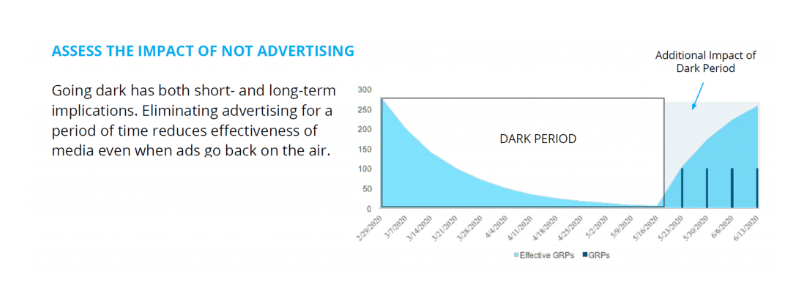
While the temptation to go dark may be strong, the negative impact on brands is pronounced. Strategic brand building and employing deals to deliver relevant content may be more cost effective than trying to rebuild to the pre-Coronavirus levels. Neilsen’s database of long-term effect models suggests that cutting advertising for the rest of 2020 could lead to an 11% revenue decrease in 2021. Going dark isn’t an option brands should be considering.