
Forget Funnels, here’s a new model for the Path to Purchase
[26th February] “Brands need a new model for path to purchase that better reflects consumers’ buying behaviour”, writes James Hankins, a consulting strategist and founder of Vizer Consulting in Marketing Week recently when proposing a new model.
This interlinked model allows all points to be connected to all potential decision nodes. The benefit being there are no pre-formulated pathways or directions. As each node is linked to every other node this theoretically represents a vast number of potential paths to purchase.
Here is that proposed model based on six different states or nodes. How does it work? The assumption at its core (and based on truth) is that pathways are non-linear and this has always been the case.
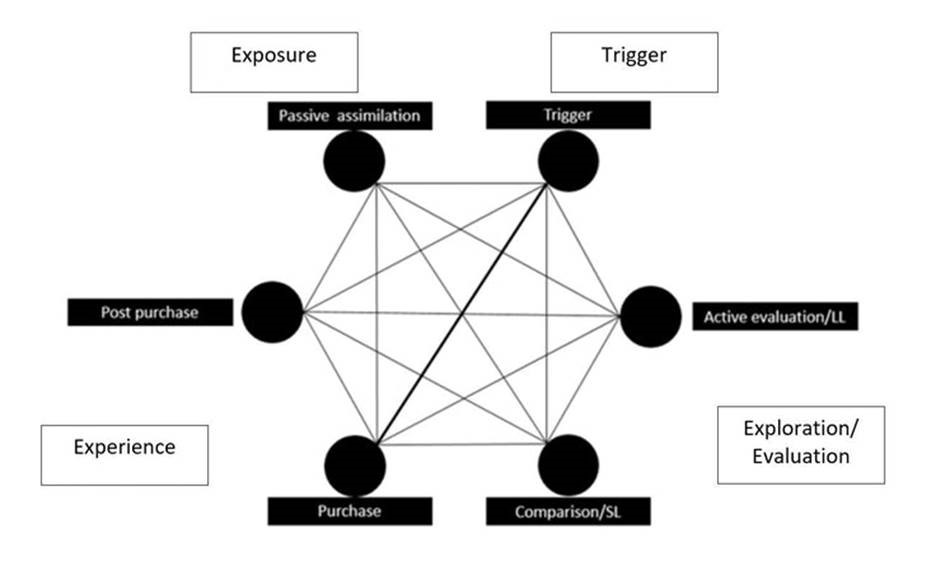
So, what does that mean? Well, simply put, a person can make their own way from A to Z any way they choose. In reality there are very few ‘fixed’ pathways and most are two-way (feedback loops and changes of mind). This model posits that an individual can start wherever and eventually make their own way to purchase, that is if they do buy in the end because not everyone always gets there. The biggest difference being that the hexagon leaves all paths open rather than forcing you a linear funnel.
Fairly general categorisations have been applied here as there are commonalities for many categories, even if these ‘nodes’ last for a micro-second.
Applying the pinball metaphor, marketers can use their investments as ‘flippers’ or ‘bumpers’ to guide people to final score (that is an extra ball) with the impact of communications acting like geometry to improve the probability you’ll score highly.
What are the implications of this for OOH? The model is supported by previous research which revealed that not only that proximity OOH delivers strong sales uplift for brands but wider locations delivering coverage also influence delayed decision making. Utilising touchpoints across environments, retail and roadside for FMCG brands for example, can affect action or in this case flip / bump consumers to that extra ball.

